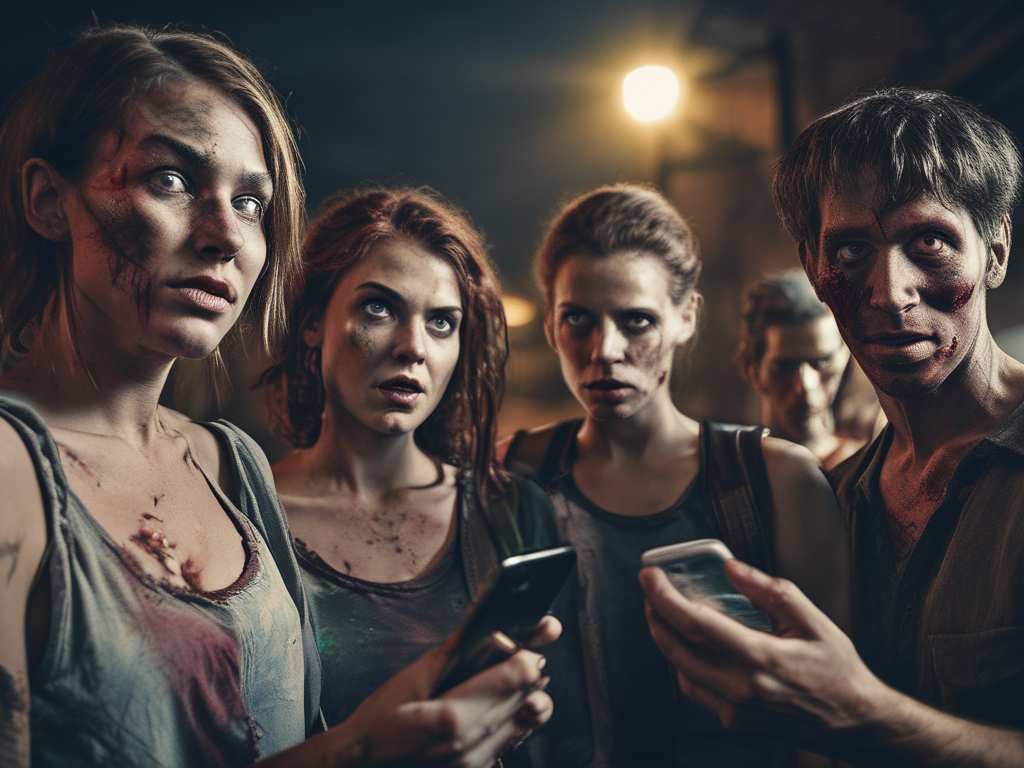
I wrote the following blog post after a trip I took in 2011. My children were 7 and 9 at the time. Having just spent a few days with my son in the same state as the trip was taken years ago, he now 20 years old, I see how my experience was a foreshadowing of the dopamine feeding apocalypse that has since taken over. A world of zombies of sort who have a hard time connecting beyond the length of their hands.
February 2011,
I had a frightening experience last week.
I found myself in a dead zone that I wasn’t going to be able to pass through for several days. In the midst of a fabulous opportunity to be in California, seeing the Pacific Ocean for the FIRST TIME, visiting old friends, loving on babies, during happy, eventful days, I was in a dead zone.
No reception. No internet access. No way of checking messages or even calling my children.
Up there in the hills of the Palisades, my cell phone provider, which shall remain nameless, sucked. (damn you at&t). I might have expected myself to breath a sigh of relief at the prospect of disappearing for a few days – off the map – under the radar. I do love my solitude after all.
I could never have imagined what I would actually experience.
Absolute panic.
I had left for my Western destination, my family happily at home with instructions to call me whenever they wanted. “I will always be accessible,” I’d said. I hadn’t left a landline number with them. Who uses landlines anymore?
On that first night, when I couldn’t get a hold of anyone it was nothing short of terrifying.
I discovered that there were certain spots on the property where I could get some service and when we were down the hill in Santa Monica, Newport Beach or Malibu reception was fair. I was even able to post once, which I had been hoping to do with pictures etc., but found it hard to do from my phone. All kinds of weird codes come up on my draft making it difficult to proofread before posting.
Two days out I was really missing my kids and my keyboard.
I took a class once taught by this incredible woman whose name I have forgotten but whose presence and presentation I will never forget. A fireball of intellectual and spiritual inspiration, she was one of the first women on faculty of Moody Bible Institute in Chicago. She had been invited to teach a class off campus about the affects of media on our society based on Neil Postma’s book, Amusing Ourselves to Death. She thought it so important to get the information out that she came to teach the class just three weeks out of open heart surgery.
She told us how she gives a challenge to incoming freshman students in her class to give up their technology for a week. Most don’t make it through the seven days she told us.
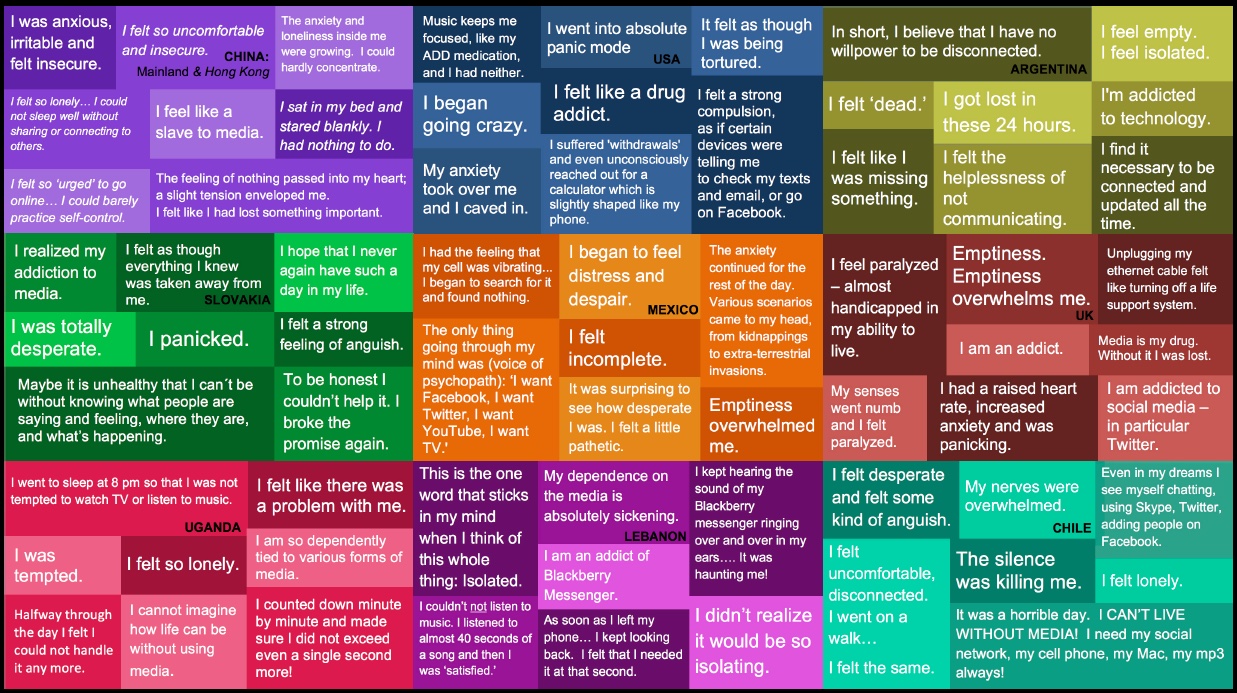
A recent study at the University of Maryland echoed her experiment. The study, published by the University’s International Centre for Media & the Public Agenda (ICMPA) and the Salzburg Academy on Media & Global Change, concluded that most students failed to go the full 24 hours without media.
The research, titled The World Unplugged, also found students’ used virtually the same words to describe their reactions.
These included emotions such as fretful, confused, anxious, irritable, insecure, nervous, restless, crazy, addicted, panicked, jealous, angry, lonely, dependent, depressed, jittery and paranoid.
Prof Susan Moeller, who led the research, said technology had changed the students’ relationships.
“Students talked about how scary it was, how addicted they were,” she said.
“They expected the frustration. But they didn’t expect to have the psychological effects, to be lonely, to be panicked, the anxiety, literally heart palpitations.
“Technology provides the social network for young people today and they have spent their entire lives being ‘plugged in’.”
One British participant reported: “I am an addict. I don’t need alcohol, cocaine or any other derailing form of social depravity…Media is my drug; without it I was lost.
Another wrote: ‘I literally didn’t know what to do with myself. Going down to the kitchen to pointlessly look in the cupboards became regular routine, as did getting a drink.’
A third said: ‘I became bulimic with my media; I starved myself for a full 15 hours and then had a full-on binge.’
While a fourth student added: “I felt like a helpless man on a lonely deserted island in the big ocean”.
That last quote was exactly how I felt that first night in California.
I felt like a helpless man on a lonely deserted island in the big ocean”.
It was scary.
Equally, when we do have access to our “media” or those we hope to connect with, our lonely deserted island no longer exists. There is an illusion of security, safety, community and connection.
I wonder if it is fair to compare some of our cyber connections and communities with mirages for our island analogy purposes.
mi·rage/məˈräZH/Noun
1. An optical illusion caused by atmospheric conditions.
2. Something that appears real or possible but is not
Some say that this world of technology has created an artificial sense of social stability. People feel as if they are connected, have community, belong somewhere online. However, in the real world we are looking at serious attachment or I would say detachment issues. You know that sense that even when you are face to face with someone – they aren’t really present as long as a phone is nearby.
For some, technology is a means to maintain a level of shallow social networking, “Meet us at Joe’s,” “I just got new boots,” “I’m bored,” “Where’s the party.”
For others, it allows a place to reconnect with people they’d lost track of. That’s how I wound up in California visiting an old friend. For many it’s a place where they can find like-minded people to share ideas with. Still for others it is a place for their most authentic self to be expressed.
I probably should have brought a journal with me on the trip. Another way to write, but I didn’t. I could have found a paper and pen, but that’s now how we role “naturally” anymore.
We have this delusion that digital connection will always be available. When we find it is not, we are lost, shipwrecked like the survivors from the show, looking around at the strangers we are in the midst of – weary of making eye contact or offering true disclosure of who we are.
They say the opposite of addiction is connection. But we have trained a generation to perceive connection as followers, texts, group chats and shared gaming.
Ghosting, the sudden disappearance of an individual one thought one had a connection with, is a technique that really requires it’s own post to understand.
This is NOT how the fundamental need for bonding, attachment, safety and community are achieved. The social impact of our inability to communicate like normal humans is obvious in the ever rising rates of mental health issues.
Anyway, I don’t have the answer. Our lives are changed forever. Humanity will never return to living with pre-tech priorities and ideals.
However, I will go down as believing there is nothing that can replace the moments when we are in the actual presence of another human being. Those moments when you have an exchange of tangible energy. When you look in someone’s eyes and there is a physiological reaction. Those encounters when your heart beats faster and your breath gets a little shallow – just by someone holding your gaze 3, 4, 5 seconds…
Those moments don’t happen all the time, but they are worth keeping our eyes off of the screens to be on the look out for.
We can scroll for hours looking through hundreds of reels for that one that captures in fifteen seconds a good reason to stop scrolling.
Or we can be expectant for a real life fifteen second encounter with another human that will do the same.
 Recover we
Leave a comment